OVERVIEW
We designed a Digital Portfolio Management Solution that modernizes how landscape companies organize, manage, and showcase their work.
The landscape industry has long relied on physical binders, printed brochures, and scattered photos stored across devices. Our solution replaces this fragmented approach with a centralized digital platform that brings every project—past, present, and ongoing—into one place.
THE CLIENT

Gravity Drive
User Experience Design Innovation Firm, USA
NOTE :
Due to a non-disclosure agreement (NDA), this case study presents a high-level overview of the problem space, design approach, and solution direction without revealing proprietary details.
LOCATION
Indianapolis, USA
TIMELINE
January - December 2025
MY ROLE
I worked as a UX designer on a multidisciplinary team, contributing to user research, insight synthesis, and identifying key problem areas. I helped translate research findings into clear product concepts and collaborated with the team throughout the design process.
TEAM
4 UX Designers
1 Product Owner
1 Developer
THE PROBLEM SPACE
Landcare companies do highly visual, physical-world work—but the tools they use to sell, design, and communicate often lag far behind. Sales conversations rely on memory, printed images, or unrelated examples pulled from the internet. Design intent gets lost in translation. Clients struggle to imagine what their space will actually look like, leading to uncertainty, revisions, and delays.
SOLUTION OVERVIEW
Our goal was to design a system that bridges this gap—turning abstract ideas into shared, visual understanding, while remaining simple enough to be used in real field workflows.
RESEARCH AND DISCOVERY
To ensure the solution was grounded in real industry needs, we used a mixed-methods research approach that combined market analysis with direct user insights. This allowed us to understand both what exists today and how landcare professionals actually work in the field.
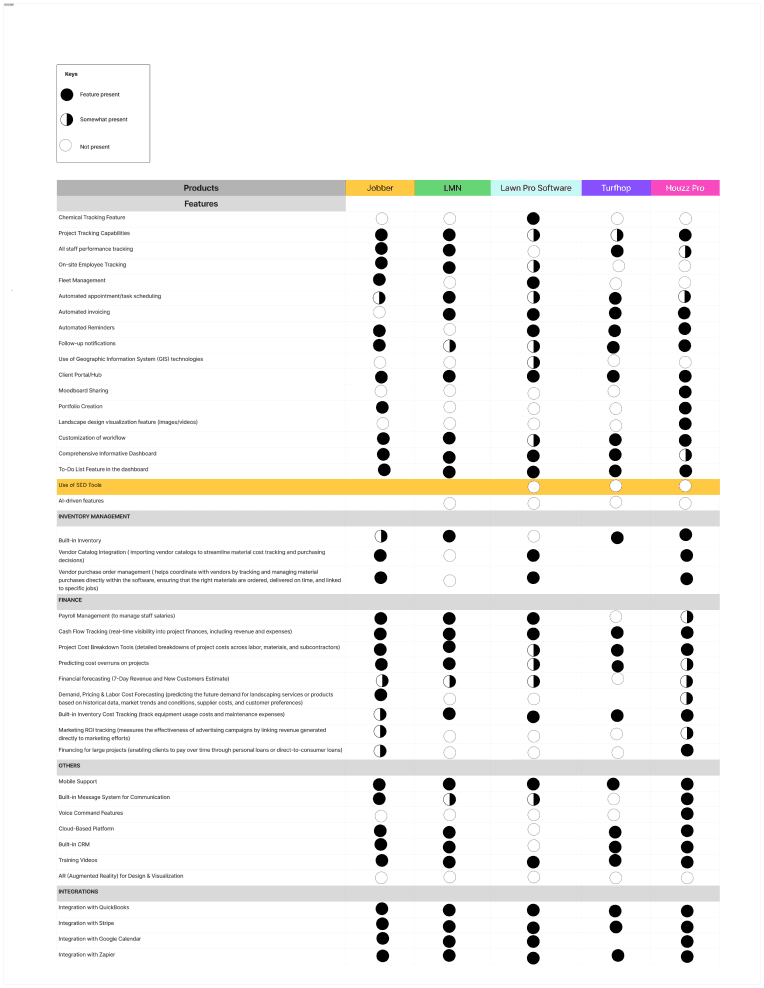
COMPETITIVE ANALYSIS
We began with a competitive analysis of existing landcare and landscape management platforms. Each product was evaluated across functionality, usability, and client-facing experience.
What we analyzed
Core features (project management, estimates, scheduling)
Visual capabilities (portfolios, imagery, presentation tools)
Support for collaboration and client communication
Use of emerging technologies (if any)

KEY INSIGHTS
KEY INSIGHTS
Client communication relied on static images, PDFs, or verbal explanations
No platform effectively supported spatial visualisation or early design alignment
Most tools were heavily optimised for operations and logistics
This revealed a clear market gap: tools helped teams execute work, but not communicate it.
USER INTERVIEWS
We conducted interviews with landscape professionals across roles, including business owners, sales leads, and designers.
Goals
Understand how projects are sold, designed, and approved
Identify pain points in presenting ideas to clients
Learn how teams currently manage portfolios and references
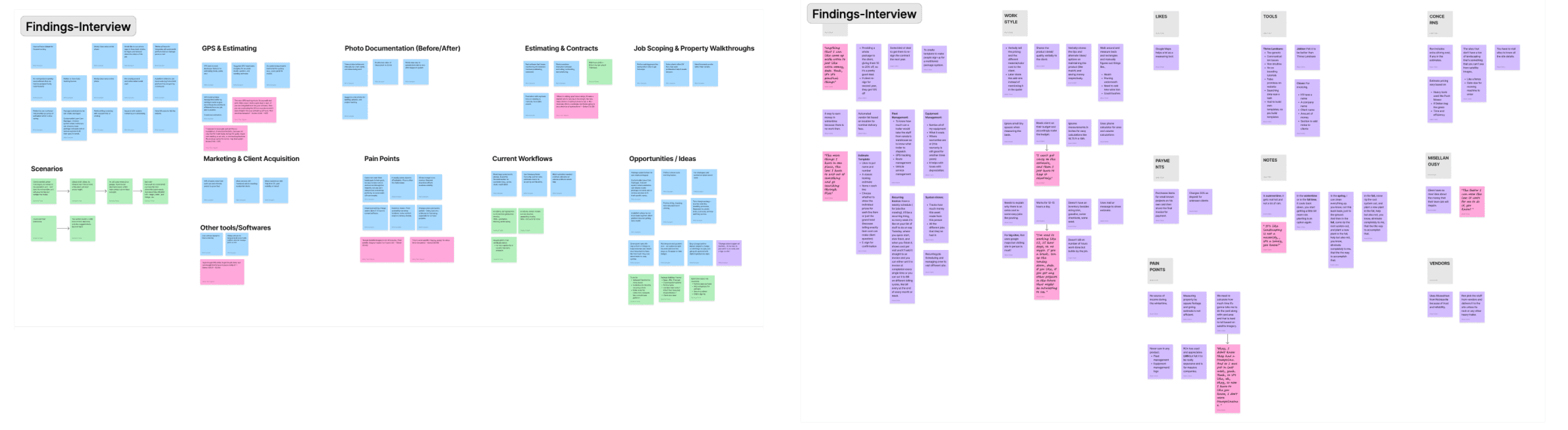
KEY FINDINGS
KEY INSIGHTS
Teams rely on personal phones, WhatsApp, or physical binders for images
Sales conversations often depend on memory or unrelated reference photos
Clients frequently struggle to visualize scale, depth, and final outcomes
Misalignment early in the process leads to rework later
This revealed a clear market gap: tools helped teams execute work, but not communicate it.
CONTEXTUAL INQUIRY
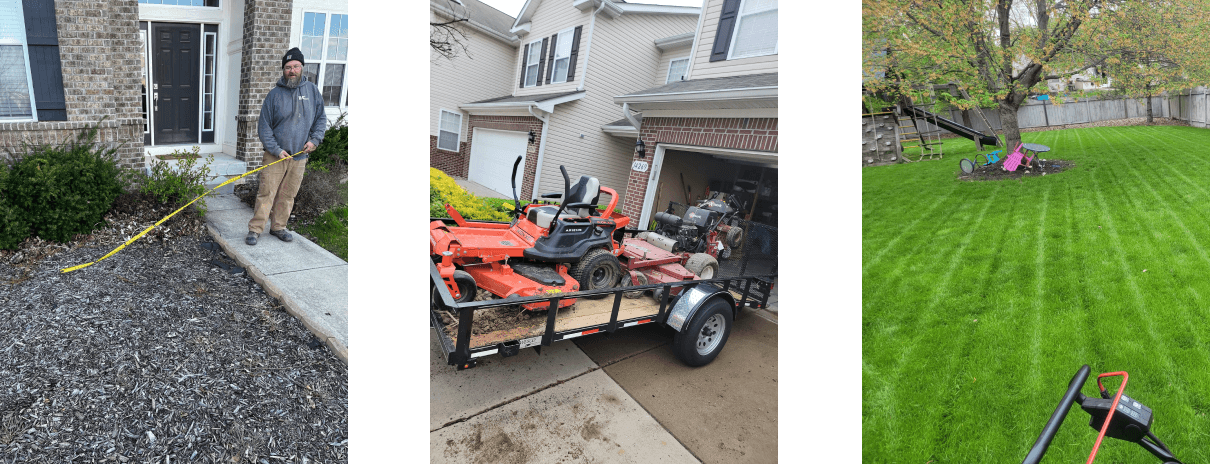
To better understand real workflows, we examined how users operate in context—during site visits, sales meetings, and internal discussions.
What we observed
Tools are rarely used live with clients
Designers and sales teams work in silos
Visual assets are scattered across devices and platforms
Decisions are made based on assumptions rather than shared visuals
This revealed a clear market gap: tools helped teams execute work, but not communicate it.
PERSONA AND USER JOURNEY MAPPING
Based on interview and observational data, we developed personas representing key stakeholders in the landcare ecosystem.
Primary personas included
Business Owners focused on credibility and closing deals
Sales Professionals responsible for client communication
Designers translating ideas into execution-ready plans
Clients who lack technical knowledge but need confidence to decide
Personas helped us balance internal efficiency with external clarity.
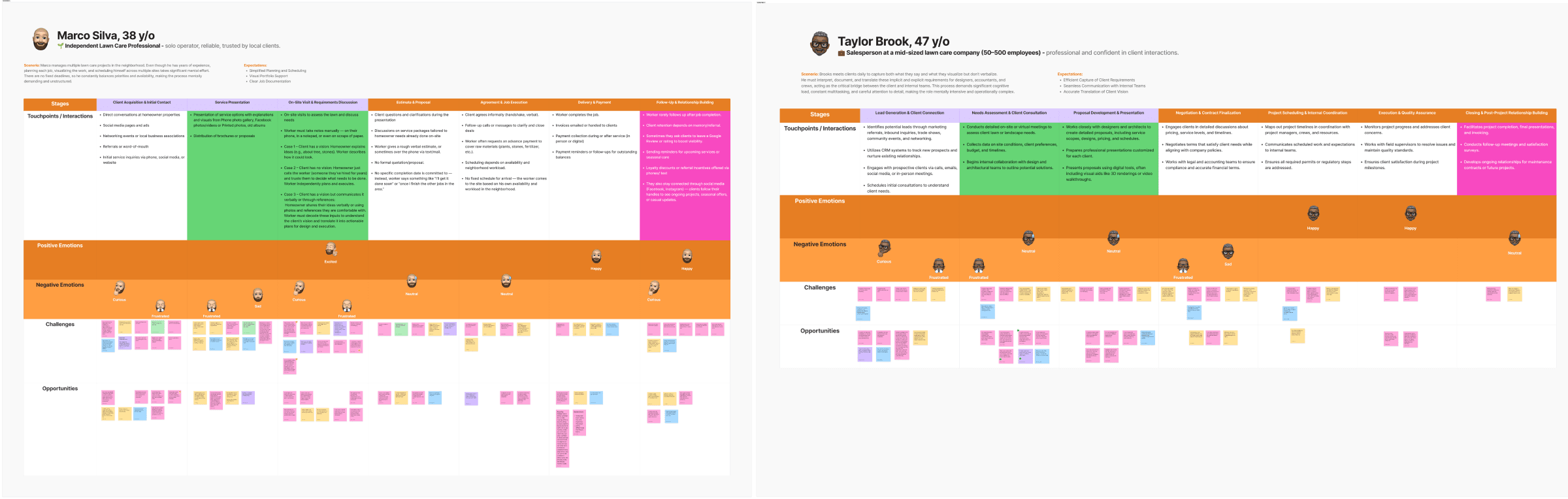
We mapped the end-to-end journey of Salesperson and Business Owner—to identify breakdowns and missed opportunities.
Critical pain points identified
Early-stage ideation lacks alignment
Clients struggle most during concept approval
Visuals are disconnected from real-world context
Project outcomes are rarely documented as reusable assets
This made it clear that the early and middle stages of the journey needed the most support.
FEATURE PRIORITIZATIONS
To focus on high-impact solutions, we used Harvey Balls analysis to evaluate potential features against:
User value
Industry relevance
Workflow compatibility
This helped us prioritize features that directly addressed communication and visualization gaps, while avoiding unnecessary operational duplication.
REDEFINING THE PROBLEM
Initially, the problem appeared to be fragmented tools and inefficient workflows. However, research revealed a deeper issue.
The challenge was not just managing projects—but making ideas visible, tangible, and believable.
Refined problem statement
Landcare teams lack effective visual and spatial tools to communicate design intent, requiring clients to imagine outcomes from flat visuals and verbal explanations. The absence of a centralized system to align and reuse work leads to confusion, slower sales cycles, and reduced trust.
Business Goals
Improve clarity and confidence in client decision-making
Shorten sales cycles through stronger visual communication
Create a centralized, reusable system for showcasing work
Elevate professionalism and consistency across teams
CONCEPTULIZATION
We translated research insights into a portfolio-first concept focused on visual communication and client alignment, rather than operational complexity.
Early ideation explored multiple directions, including project repositories, presentation-led flows, and visualization-centric experiences.
Through team discussions and partner feedback, we aligned on a digital portfolio system enhanced with moodboards and AR to support real sales and design conversations.
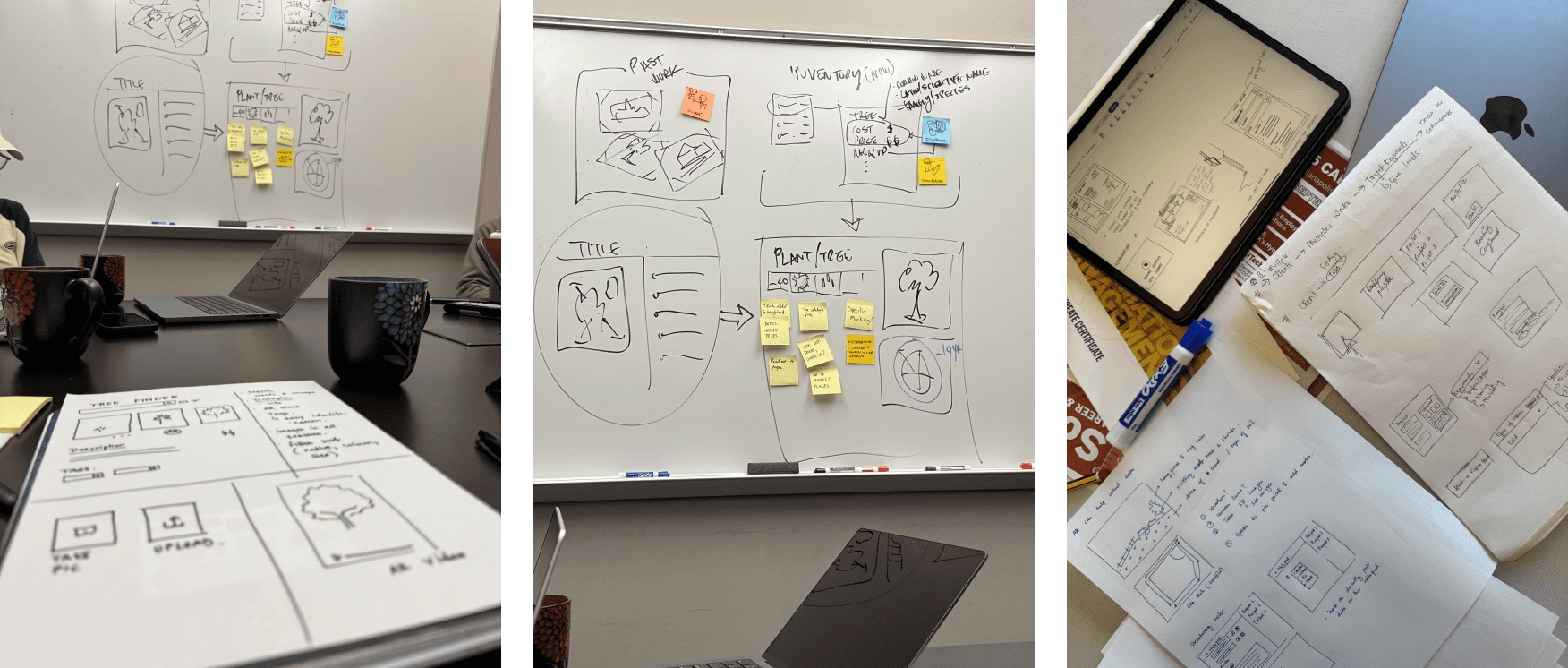
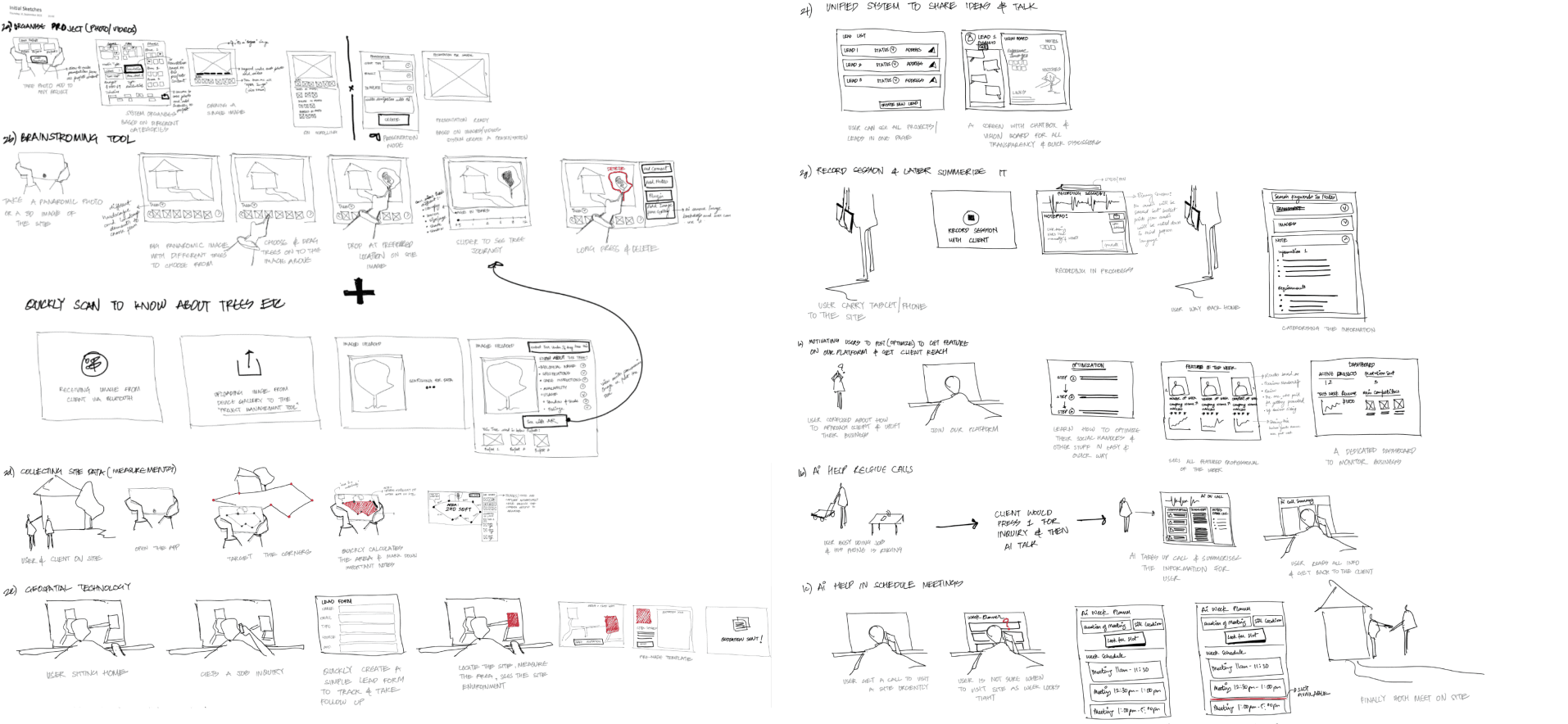
Multiple Whiteboard brainstorming sessions and over 60+ hand-drawn ideation sketches
FINAL SOLUTION
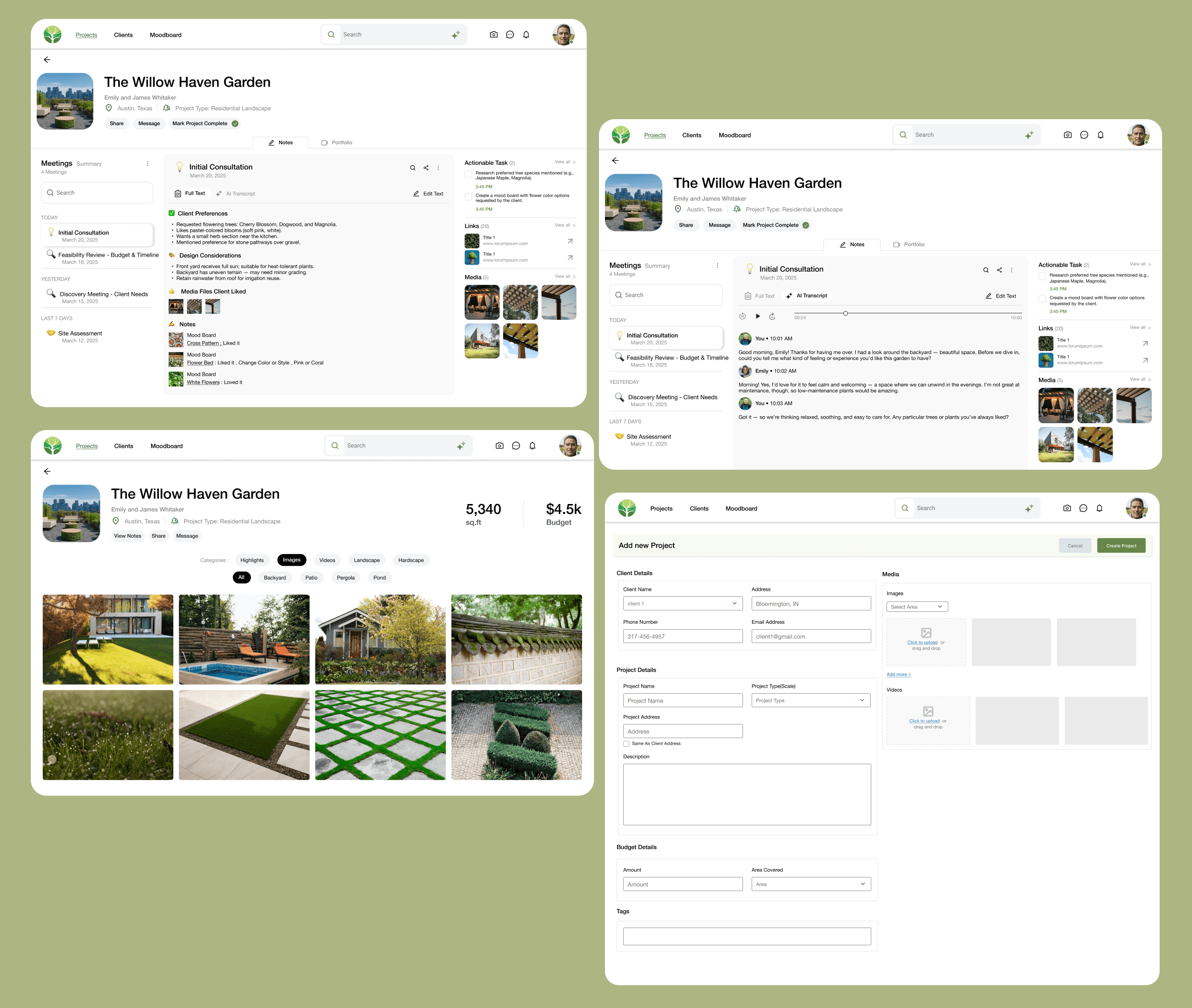
FEATURE 1 : CENTRALIZED DIGITAL PORTFOLIO
Problem : Project images and documents are scattered across devices, folders, and physical binders, making it hard to reuse past work during sales conversations.
Solution :
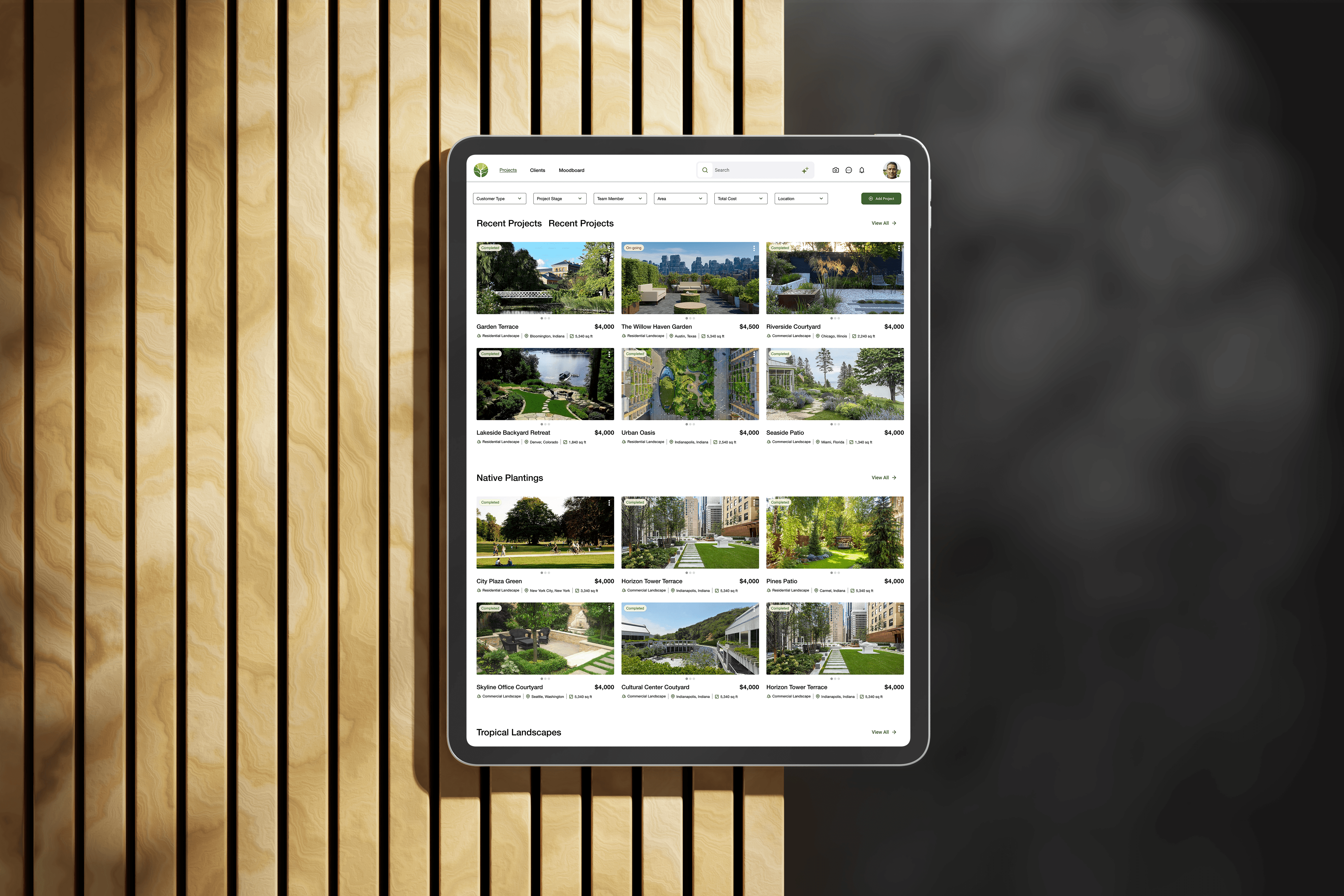
A single, searchable platform to manage all projects—past, present, and ongoing.
FINAL SOLUTION
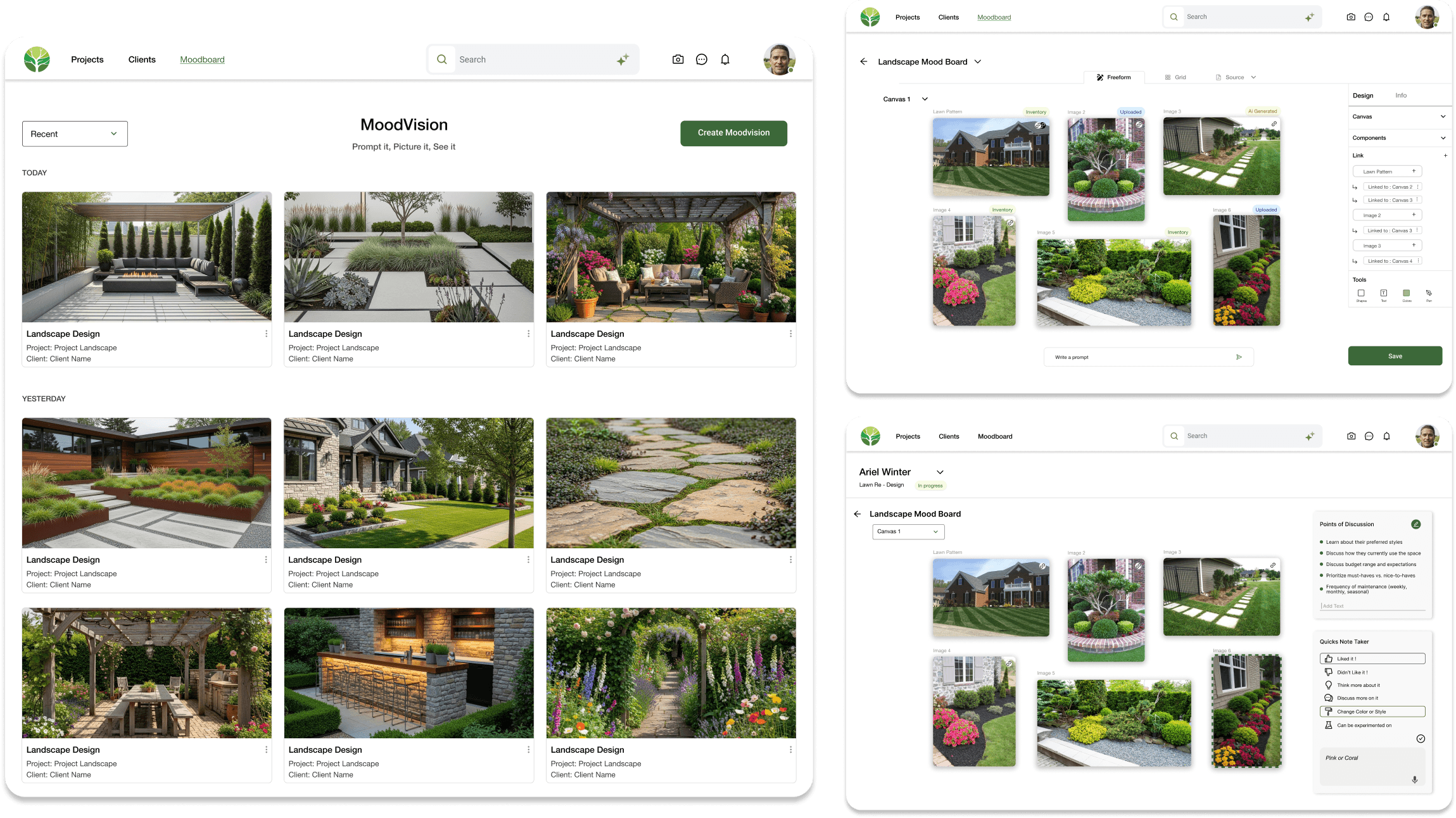
FEATURE 2 : MOODVISION - AI POWERED MOODBOARDS
Problem
Clients struggle to understand design intent early, leading to misalignment and rework later.
Solution
An AI-assisted moodboarding tool that helps teams and clients align visually from the start.
FINAL SOLUTION
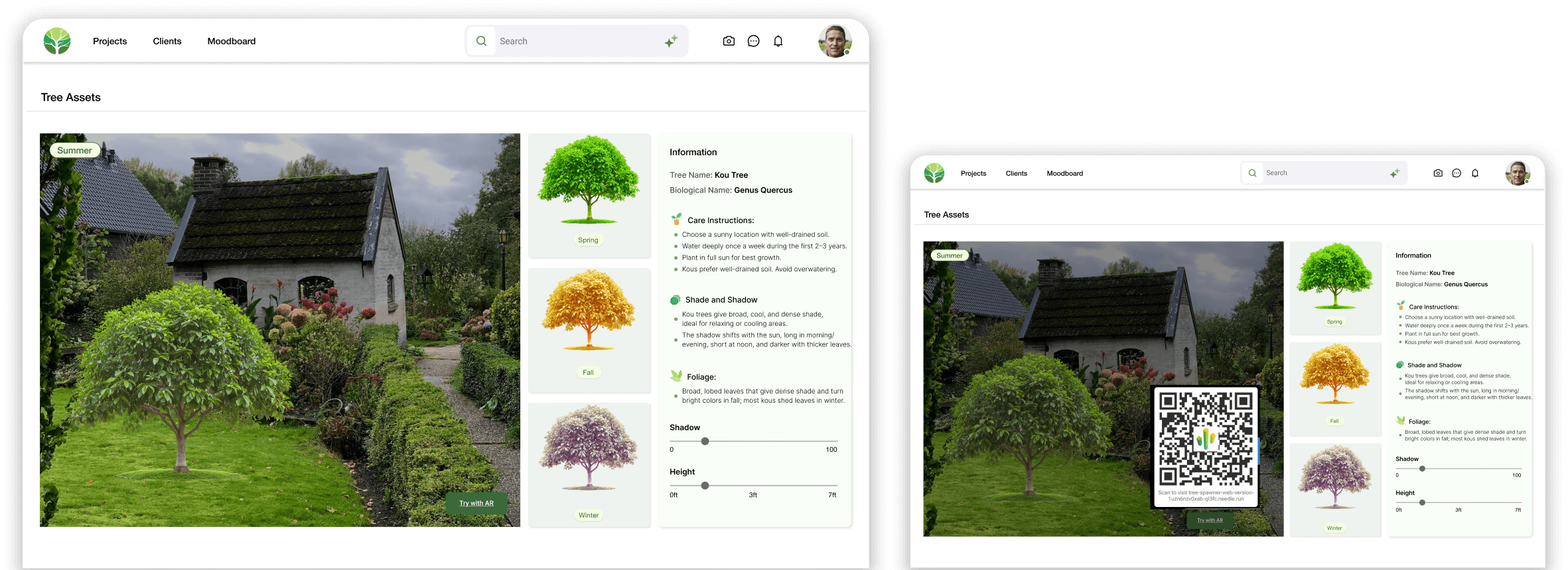
FEATURE 3: AUGUMENTED REALITY VISUALIZATION
Problem
Flat images and verbal explanations fail to communicate scale, placement, and spatial context.
Solution
AR allows clients to visualize landscaping elements in their actual environment.
FINAL SOLUTION
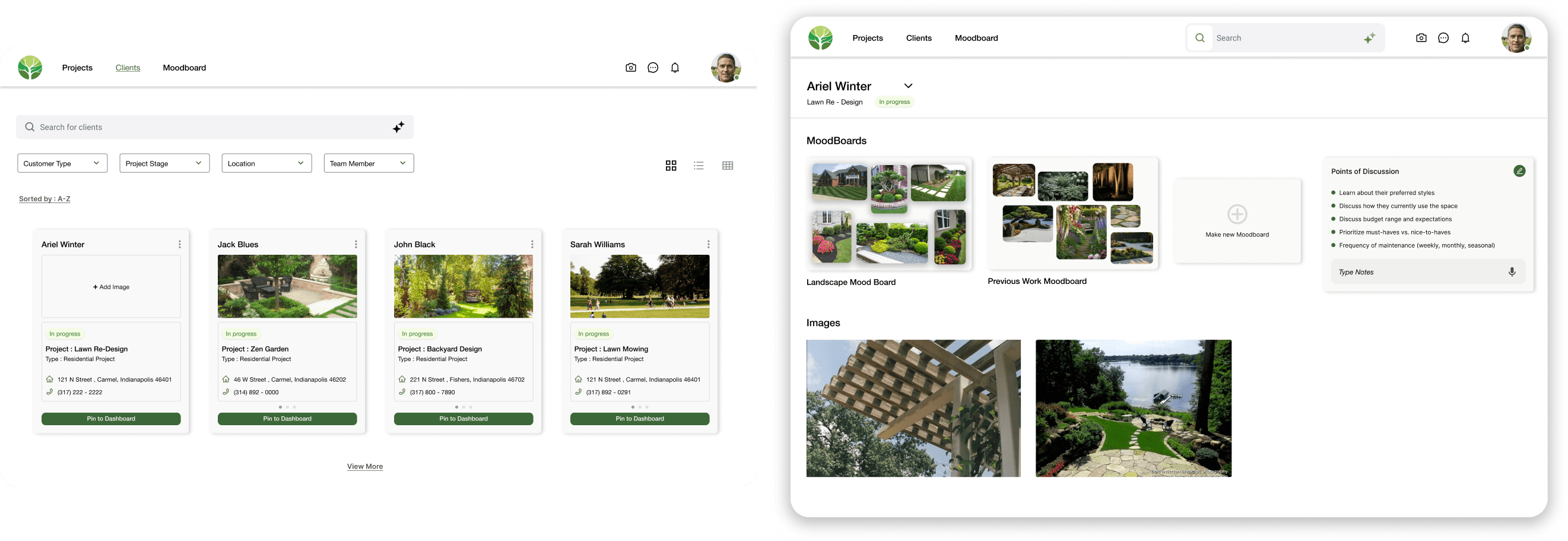
FEATURE 4 : CLIENT DASHBOARD
Problem
Client information, references, and feedback are scattered across emails, messages, and personal notes, leading to missed details and misalignment over time.
Solution
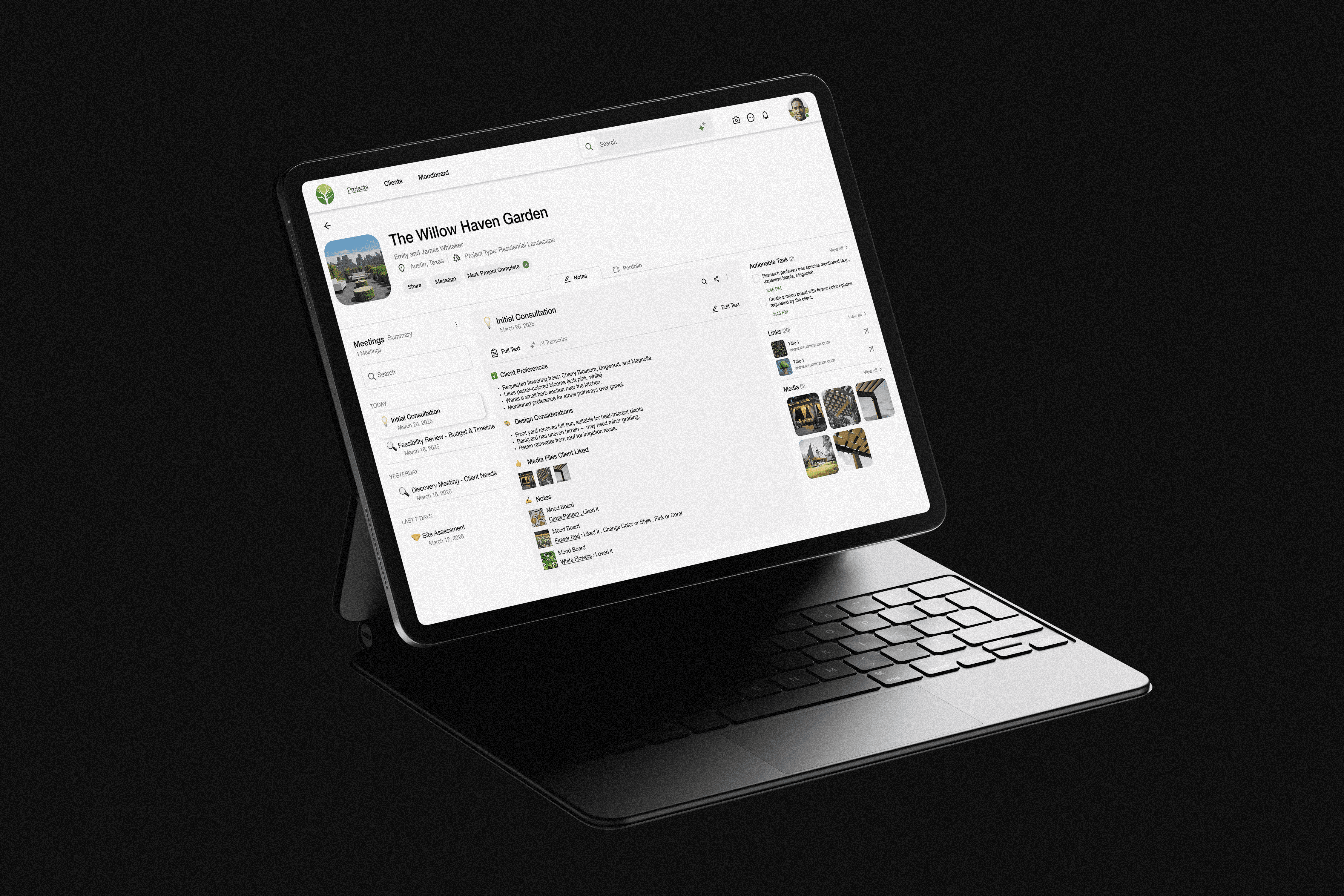
A dedicated Client Dashboard created for every client, serving as the single source of truth during all client interactions.
FINAL SOLUTION
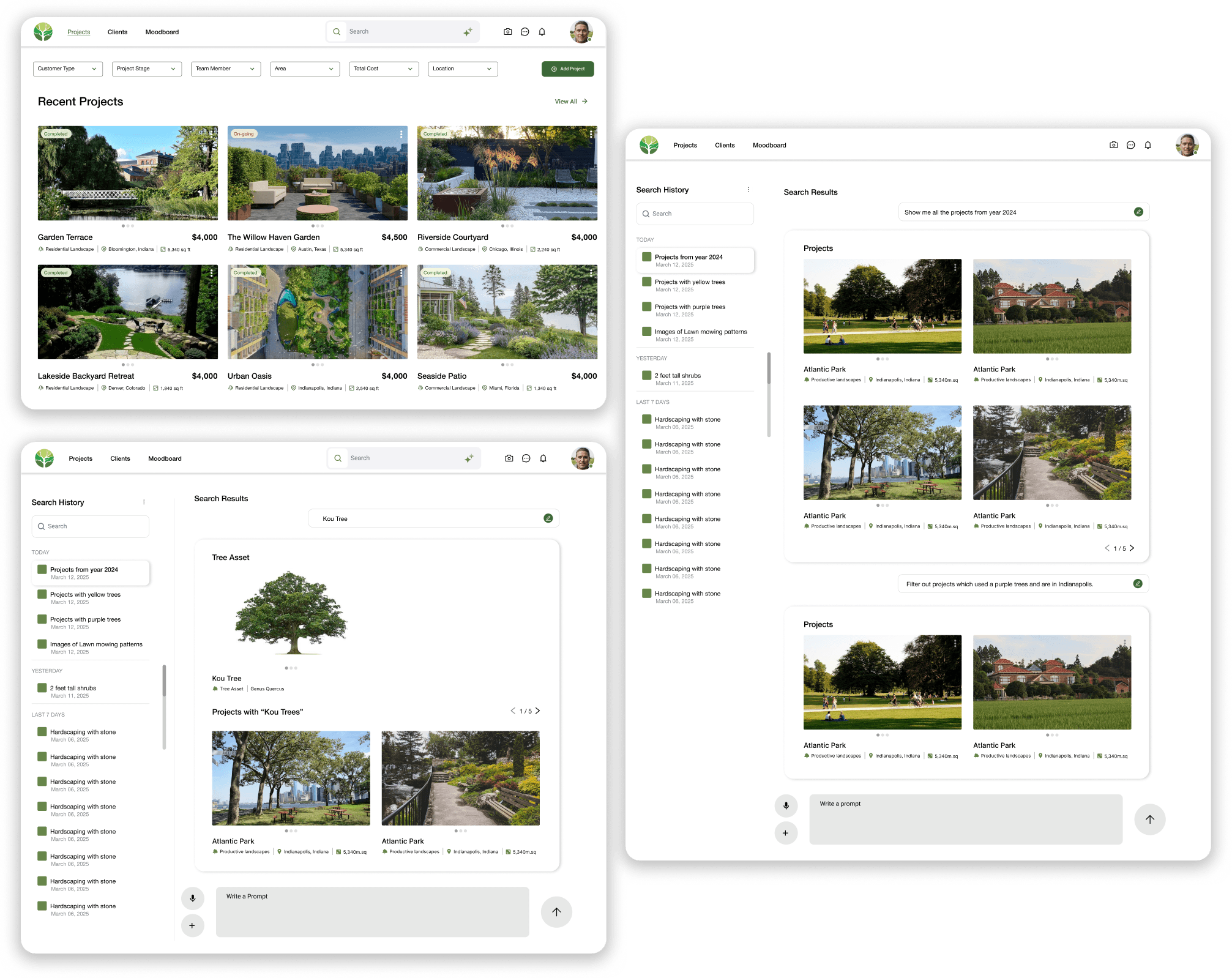
FEATURE 5: SMART INVENTORY AND ASSET LIBRARY
Problem
Design and sales teams often rely on external websites or memory to reference plants and materials, leading to inaccuracies and inefficiencies.
Solution
A built-in Smart Inventory that provides structured, reliable information about landscape assets.
KEY TAKEAWAYS
Centralization reduces friction : Bringing projects, communication, and assets into one system lowered cognitive load.
Innovation must feel simple : AR and AI worked only when seamlessly integrated into existing workflows.
Real-world context changes design priorities : Field-based, time-constrained users require fast, minimal, and intuitive interfaces.